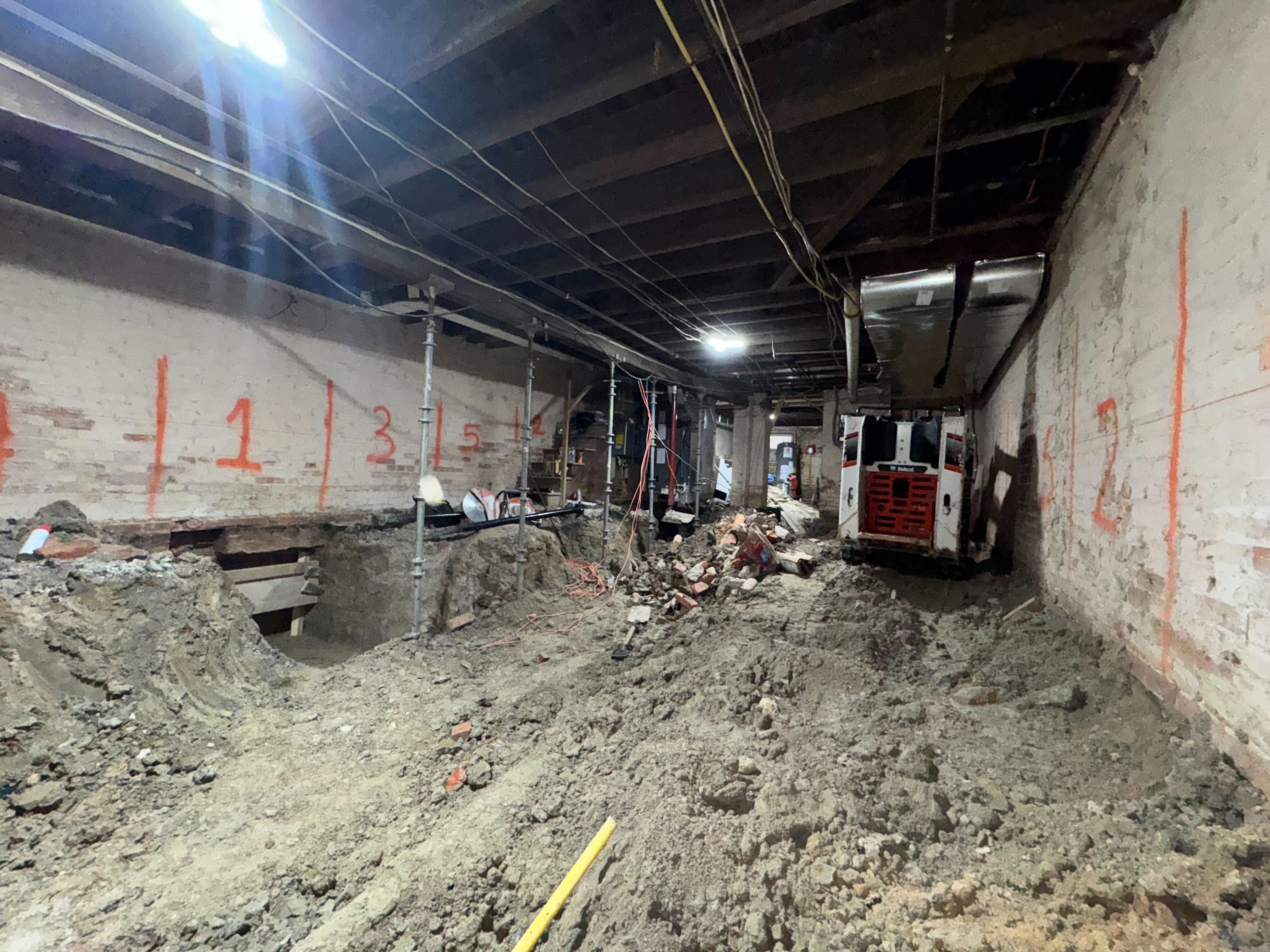
What Is Basement Underpinning?
First, a quick definition. A basement dig-out—also called basement floor lowering or simply basement lowering—is a heavy construction process that involves excavating soil beneath an existing home to increase headroom, deepen an existing basement and converting it into usable space. Basement underpinning, by contrast, is the structural foundation work required when you need to dig below your existing footings. The two services are often performed together, but they're distinct—and on this page we cover both in detail.
Basement underpinning extends your existing foundation deeper into the ground so it can support your home while you lower the basement floor. It's essentially building new, deeper foundation supports beneath your current ones—while your house stays standing on top of them.
You need underpinning when your current footings aren't deep enough for your planned slab elevation. Dig below unsupported footings and you're removing the soil that's bearing your house's entire load. The result? Foundation settlement, wall cracks, structural failure—the kind of problems that cost six figures to fix and can make your house uninhabitable.
In DC rowhouses where you share walls with neighbors, the stakes are even higher. Destabilize your foundation and you can damage their property too. (And yes, you'll be liable for those repairs.)
Basement Floor Lowering (Dig-Out) vs. Basement Underpinning: Two Different Services
These are two different construction services that solve different problems. Many DC basement projects involve both—but not all do. Here's how a structural engineer determines which apply to your home, and what each one actually involves.
| Basement Floor Lowering (Dig-Out) | Basement Underpinning |
|---|
| What it is | Excavation of soil inside the basement footprint plus pouring a new, lower concrete slab | Structural work that extends existing foundation walls/footings deeper into the ground |
| When it's required | Your existing footings already sit 12+ inches below your target floor elevation | Your target floor sits below the bottom of your existing footings, or you have shallow/party-wall foundations |
| Typical cost (DC) | $40,000–$100,000 | $100,000–$200,000+ |
| Timeline | 4–8 weeks construction (3–6 months total with permits) | 3–6 months construction (6–12 months total with permits) |
| Permits & inspections | DOB permit, standard inspections, often no TPSIA required | DOB structural permit, TPSIA third-party inspections, neighbor notification (party-wall) |
| Structural risk | Lower—but still requires engineering sign-off on soil bearing and drainage | High—mistakes can cause foundation failure or damage to neighboring homes |
| Often combined? | Sometimes stands alone when foundations are already deep enough | Yes—most underpinning projects include a dig-out and new slab |
You May Only Need a Dig-Out/Slab Lowering If:
- Existing footings are already 12+ inches below your target floor elevation
- Your engineer confirms the existing foundation depth works for your planned excavation
- You're only lowering the floor a few inches
You Likely Need Underpinning If:
- Your existing footings sit at or above your planned finished floor elevation
- You're lowering the floor more than 12–18 inches with shallow foundations
- You have a party wall and need to excavate below the shared footing
- Your structural engineer's assessment requires underpinning for load transfer
- You're in an older DC rowhouse with rubble stone foundations (common in neighborhoods like Georgetown, Capitol Hill, Shaw)
Never, and we mean never, assume you can skip underpinning to save money. The structural risks far outweigh any cost savings. A licensed structural engineer needs to make this call after physically evaluating your foundation conditions through test pits. Guessing wrong means foundation failure, emergency repairs, and costs that dwarf what proper underpinning would have cost in the first place.
Why DC Homeowners Lower the Basement Floor
Before you commit six figures to a basement floor lowering or dig-out project, it helps to understand exactly what you get out of it. DC homeowners pursue this work for five main reasons:
1. Add 400–800 sq ft of livable space
Converting a 6-foot crawl space or low basement into a full-height basement effectively adds a floor to your home without changing your footprint or going through DC's tougher above-grade addition reviews. For a typical DC rowhouse, that's 400–800 additional square feet of usable space below grade.
2. Generate $18,000–$36,000/yr in rental income
A legal, separately-metered basement apartment in DC rents for roughly $1,500–$3,000/month depending on neighborhood, finish level, and whether it includes a private entrance. In Capitol Hill, Columbia Heights, Shaw, and Dupont Circle, demand is consistent and turnover is low. Over a 10-year hold, that's $180K–$360K of additional income.
3. Add $100,000–$200,000 to your home's resale value
DC buyers consistently pay more for homes with finished, full-height basements—especially when the lower level can function as an in-law suite or rental unit. A well-executed dig-out plus finish typically returns 70–100% of project cost at sale, and in hot DC submarkets the ROI can exceed 100%.
4. Create the room you actually need
Home office, gym, in-law suite, media room, kids' play space, guest bedroom. With 8–9 feet of finished ceiling height, the basement stops being damp storage and starts being a real part of your home. For families who've outgrown their upstairs but love their block, this is often the only practical answer.
5. Avoid the cost and disruption of moving
Buying a larger home in your DC neighborhood often means $300,000+ in transaction costs (agent commissions, transfer/recordation taxes, a much bigger mortgage, moving expenses), plus saying goodbye to schools, neighbors, and commute patterns you've built your life around. Lowering the floor keeps you put while still solving the space problem.
Our Basement Underpinning Process in DC
We've done this enough times to have it down to a system. Six phases that take you from "Do I need underpinning?" to "Here's my finished, code-compliant basement with 7+ feet of ceiling height."
Phase 1: Structural Engineering & Design (Test Pits)
A licensed structural engineer comes to your property and digs test pits in your basement floor to expose your existing footings. They measure footing depths and widths, review soil conditions, check for rubble stone foundations (common in older DC homes), and assess load-bearing capacity.
Then they design the underpinning sequence—which sections get underpinned first, how deep each pin goes, what reinforcing steel is required. The stamped construction documents specify pit locations, excavation depths, rebar requirements, and special inspection hold-points. These drawings are what get submitted for your building permit.
Phase 2: Third-Party Special Inspection Planning (TPSIA)
Underpinning projects in DC require Third-Party Special Inspection Agency oversight per ICC special inspection standards. An independent engineering firm inspects and certifies critical stages—excavation depths, rebar placement, concrete pours. Your contractor cannot proceed past inspection hold-points without TPSIA clearance.
We coordinate TPSIA approval, inspection scheduling, and hold-point clearances so you're never the one chasing down inspectors or wondering why work has stopped. (Because work will stop if TPSIA hasn't signed off. That's how the system works.)
Phase 3: Neighbor Notification & Permits
DC requires written notification to adjacent property owners and a 30-day posted public notice sign before your permit gets issued. This is especially critical in rowhouse situations where you share party walls.
Neighbor notification checklist:
- Written notice to adjacent owners (certified mail recommended for proof)
- Public notice sign posted at property for 30+ days
- Address neighbor concerns before construction starts (this saves headaches later)
- Submit proof of notification with your permit application to DC Department of Buildings
We handle permit applications for the correct permit type—foundation/structural permits that include underpinning, sheeting, and shoring. ("Foundation-to-grade" permits specifically exclude underpinning work, so you need to apply for the right one.)
If you're in a historic district like Georgetown or Capitol Hill, add Historic Preservation Office review to your timeline. Ground-disturbing work gets scrutinized. If window wells extend into public space (sidewalks), that's a separate DDOT public space permit.
Permitting in DC typically takes 6-12 weeks. Sometimes faster. Often slower. (It's DC.)
Phase 4: Staged Excavation & Underpinning Installation
Once permits are approved and TPSIA is engaged, construction starts. Here's the sequence:
Site preparation: Protect utilities, set up shoring/bracing, establish safe access. Your basement becomes a construction zone.
First sequence pits: Excavate alternating pits around your foundation perimeter (typically 3–5 pits at a time, each 3-4 feet wide). We never dig adjacent pits simultaneously—that would remove too much support. It's staged strategically.
TPSIA inspection #1: Third-party inspector verifies excavation depth and soil conditions. No proceeding until they sign off.
Rebar & formwork: Install reinforcing steel and forms in each pit according to engineer's specifications.
TPSIA inspection #2: Inspector verifies rebar placement and form integrity. Again, no moving forward without clearance.
Concrete placement: Pour concrete pins and let them cure (3–7 days minimum). Each pin is essentially a new foundation support extending deeper into the ground.
TPSIA inspection #3: Verify concrete reaches required strength. This gets tested every 7 days until it hits plan specifications. (Concrete strength testing is not optional.)
Concrete grouting: Fill the gap between the new pin and your existing footing, ensuring load transfer.
Second sequence pits: Repeat the entire process for the next set of alternating pits. Then the third sequence. Then the fourth. Most full-perimeter underpinning takes 5–7 sequences to complete.
Finishing steps: All perimeter sections underpinned and cured. Final structural inspection confirms everything meets code.
The whole underpinning construction phase typically takes 8–12 weeks. It's methodical, it's slow, and it cannot be rushed. (Well, it can, but that's how foundations fail.)
Phase 5: Interior Excavation
With underpinning complete and your foundation now supported at the proper depth, our crews safely excavate the remaining soil from the interior basement floor. Everything gets hauled out—bucket by bucket if access is tight, with small equipment if we can fit it through basement access.
We grade and compact the soil in preparation for your new lower slab. This phase takes 1–4 weeks depending on how much material needs removal.
From the Field: Georgetown & Historic DC
In neighborhoods like Georgetown, Capitol Hill, and Kalorama, excavation crews regularly hit surprises buried for 150+ years: old brick cisterns, abandoned coal chutes, hand-laid rubble stone footings, even fragments of pre-Civil War foundations. On one Georgetown project, our crew uncovered an intact 1880s brick well shaft that DC's Historic Preservation Office wanted documented before we could continue. This is why historic DC dig-outs need contractors who know to slow down, document carefully, and coordinate with HPO when something significant turns up—and budget contingency for the days lost to discovery and review.
Phase 6: Waterproofing, Utilities & Finishing
Final steps include waterproofing newly exposed foundation walls (you've just created more below-grade surface area), adjusting plumbing drains to the new floor level, installing backwater valves per DC Code requirements, running new utilities, installing code-compliant egress windows, and then pouring the new lower slab.
Coordinate with DC Water for backwater valve requirements and to verify invert elevations for your sewer lateral. (DC's plumbing code is specific about this.)
This finishing phase adds another 2–4 weeks to your timeline.
Ready to move forward with confidence? Schedule your in-home consultation and we'll assess your foundation conditions, determine if underpinning is necessary, and provide transparent pricing.
Costs & Timeline in Washington, DC
Cost Ranges
Basement underpinning costs in DC range from $100,000 to $200,000+ for full-perimeter residential projects. Where you land in that range depends on:
- Linear feet of underpinning: More perimeter = more cost. Rowhouses often need 50-80 linear feet. Detached homes can be 100+ feet.
- Depth per pin: Going 2 feet deeper costs less than going 4 feet deeper. More excavation, more concrete, more time.
- Soil conditions: Rocky soil, groundwater, clay—all affect excavation difficulty and cost.
- Access constraints: Tight basement access means everything gets carried out by hand. Slow and expensive.
- Party walls: Shared foundations with neighbors require extra care, monitoring, and sometimes agreements.
- Historic property review: HPO review adds time and sometimes requires specialized approaches.
For straightforward dig-out projects (no underpinning needed because footings are already deep enough), costs typically run $40,000–$100,000.
Return on Investment: What You Get Back
A basement dig-out or full underpinning project is a major investment—but for most DC homeowners, the numbers work. Here's a realistic picture of the return:
- Rental income (if you build a basement apartment): A legal DC basement apartment rents for $1,500–$3,000/month, or $18,000–$36,000 per year. Over a 10-year hold, that's $180K–$360K of gross income—enough to fully pay back the project plus a meaningful return.
- Resale value uplift: Finished, full-height DC basements add an estimated $100,000–$200,000 to home value. National data shows basement remodels typically return 70–86% of cost at sale (Remodeling Magazine's Cost vs. Value Report), and in hot DC submarkets the ROI often exceeds 100%.
- Payback window: Owner-occupied projects with a legal rental unit typically pay back in 5–10 years through rental income alone. Resale-driven projects depend on market timing but generally recoup most or all of project cost within one sale cycle.
- What doesn't show up in spreadsheets: The cost of not doing the project—needing to move to a larger home, losing your neighborhood and school zone, or living without the space your family actually needs.
ROI varies widely based on neighborhood, finish quality, whether you create a legal rental unit, and current market conditions. A free in-home consultation gives you a real number for your specific home.
DC-Specific Cost Drivers
Third-Party Special Inspections: Budget $3,000–$8,000+ for TPSIA coordination. This isn't optional—it's required.
Permit fees and plan review: Department of Buildings fees plus third-party plan review costs.
Party wall agreements or structural monitoring: If you're underpinning a shared wall, your neighbor may require monitoring equipment to track any movement. Add $2,000-$5,000.
DDOT Public Space permits: If egress window wells extend into sidewalk area, expect another permit and fees.
Timeline Expectations
Here's what a realistic DC basement underpinning timeline looks like:
- Engineering & design (test pits): 2–4 weeks
- Permitting (including neighbor notification): 6–12 weeks (because it's DC)
- Underpinning construction: 8–12 weeks (staged sequencing cannot be rushed)
- Interior excavation: 1–4 weeks
- Utilities, waterproofing & new slab: 2–4 weeks
Total project duration: 6–12 months from engineering kickoff (test pits) to certificate of occupancy. Plan accordingly. Anyone promising significantly faster timelines is either cutting corners or doesn't understand DC's inspection requirements.
The Risks of Skipping Underpinning (Don't Do This)
Some homeowners are tempted to skip underpinning to save money. Or contractors suggest "just digging carefully" or inappropriate "bench footing" approaches—which are illegal in DC when underpinning is actually required.
Why cutting corners is catastrophically dangerous:
Foundation Settlement and Failure
Excavating below an unsupported footing removes the soil bearing your house's entire load. The footing and wall settle, crack, or rotate inward. In severe cases, catastrophic wall collapse occurs. This isn't theoretical—it happens. Your house becomes structurally unsound and potentially uninhabitable.
Structural Damage to Adjacent Properties
In DC's dense rowhouse neighborhoods (Capitol Hill, Shaw, Columbia Heights, Dupont Circle), digging below a shared party wall footing without proper underpinning can cause your neighbor's foundation to settle. Their walls crack. Their floors become unlevel. Doors won't close.
And guess who's liable for repairs? You are. We're talking tens of thousands of dollars in damages—possibly more than underpinning would have cost in the first place.
Code Violations and Stop-Work Orders
DOB inspectors will red-tag unpermitted or improperly executed underpinning. You'll face stop-work orders, fines, and potentially have to demolish and rebuild portions that don't meet code. The project gets exponentially more expensive because now you're fixing mistakes under emergency conditions.
Voided Insurance and Mortgage Issues
Many homeowners insurance policies exclude coverage for unpermitted structural work. If foundation issues arise from your unpermitted underpinning attempt, you're on your own financially. Good luck with that claim.
Unpermitted work also complicates refinancing or resale. Title companies find it. Buyers' inspectors find it. Banks get nervous. Your property value tanks.
Benching vs. Underpinning (They're Not Interchangeable)
Some contractors suggest "benching" (cutting a stepped ledge in your foundation) as a cheaper alternative to underpinning. Benching has legitimate engineering uses in certain scenarios, but it's not a substitute for underpinning when you need to transfer loads deeper.
Benching works when your footing is already deep enough and you're just creating a level shelf for finishing work. It doesn't work when you need to excavate below your footing's bearing depth. Always follow your structural engineer's recommendations, not a contractor's "I've done it this way before" approach.
DC Basement Underpinning FAQ
Can I DIY a basement dig-out or underpinning project?
No—and even attempting it can put your home and your neighbors' homes at serious risk. A basement dig-out involves excavating tons of soil from beneath your home's foundation. Underpinning goes further: it requires temporarily transferring the entire structural load of your house onto staged supports while you build new, deeper footings. Mistakes can cause foundation settlement, cracked walls, and in worst cases, partial structural failure. Beyond the physical risks, DC requires permitted contractors, third-party special inspections, neighbor notification, and structural engineer sign-off. None of those will be issued to a homeowner doing the work themselves, and proceeding without them voids your homeowner's insurance and exposes you to personal liability if anything goes wrong. Use a licensed contractor with documented underpinning experience in DC. Always.
How long do DC permits take for a basement dig-out or underpinning project?
Plan on 8–16 weeks from submitting a complete application to receiving an approved permit. The timeline breaks down roughly as: 2–4 weeks for initial DOB review, 4–8 weeks if your project requires HPO (Historic Preservation Office) review (common in Georgetown, Capitol Hill, Dupont, and other historic districts), 2–4 weeks for neighbor notification posting, and an additional 1–2 weeks for any plan corrections requested by reviewers. A complete, well-prepared application from an experienced architect/engineer can clear in as little as 6 weeks; an incomplete application can drag past 6 months. We coordinate the entire permit process for our clients and pre-screen submissions to minimize back-and-forth.
Do I need third-party inspections?
Yes. Underpinning falls under TPSIA requirements. An independent engineering firm must inspect critical stages—excavation, rebar placement, concrete pours. Your contractor cannot proceed past hold-points without TPSIA clearance. Budget $3,000-$8,000+ for this.
Do I have to notify my neighbors?
Yes. DC requires written notification to adjacent property owners and a 30-day posted public notice sign. You must submit proof of notification with your permit application. This is especially important in rowhouse situations. Skip this step and your permit gets rejected.
Will lowering my basement floor count as an "addition"?
Usually no. Zoning Administrator Interpretation ZA-012 clarifies that lowering a slab to increase headroom (6'6" or more) typically doesn't increase Gross Floor Area for zoning purposes. Basement space already counted in GFA; you're just making it more usable. Confirm with your architect for your specific situation, especially if you're converting a cellar (excluded from GFA) to a basement (included in GFA).
How do I know if I need underpinning?
A structural engineer conducts a site assessment with test pits. If your footings sit at or above your planned finished floor elevation, you need underpinning. If they're 12+ inches below your target, a simple dig-out may work. The engineer makes this determination—never guess or assume.
Can I underpin just part of my foundation?
Sometimes. If only one section has shallow footings (maybe the rear addition was built later with different foundation depths), you may underpin just that area. Your structural engineer will design the most cost-effective safe solution. But if you're digging the entire floor down, you'll likely need full-perimeter underpinning.
What's the difference between underpinning and shoring?
Underpinning deepens your foundation permanently—it's the new structural support for your house. Shoring (sheet piling, soldier piles, bracing) is typically temporary protection during construction to prevent cave-ins and protect adjacent properties. Many deep excavation projects use both underpinning and shoring systems.
Can I live in my house during underpinning?
Usually yes, but it's not comfortable. Expect significant noise, dust, vibration, and limited basement access for weeks. Some homeowners with very deep underpinning projects choose to move out temporarily. Most tough it out, but be realistic about the disruption—especially if you work from home.
Why Choose Us for Basement Underpinning in DC
Proven DC Expertise
We've completed underpinning and dig-out projects across Washington—Capitol Hill, Columbia Heights, Georgetown, Kalorama, Palisades, Tenleytown, and Foxhall. We know the soil conditions (rocky in some areas, clay in others), permitting quirks, and the TPSIA firms that keep projects moving.
Twenty years of experience means we've seen every curveball DC basements can throw—rubble stone foundations, shallow laterals, party wall complications, historic preservation requirements. (There's always a curveball. We just know how to handle them.)
Engineering & TPSIA Coordination
We work with licensed structural engineers from day one and handle all Third-Party Special Inspection coordination. You won't get caught between contractors, engineers, and inspectors who've never worked together before. We've got established relationships with TPSIA firms, which means smoother scheduling and fewer delays.
One Company Handles All Construction Stages
From test pits to structural engineering coordination, permitting, underpinning installation, excavation, waterproofing, utilities, egress windows, and final slab—we handle it all. You're not coordinating five different subcontractors. We take complete responsibility and ownership of the project.
Our estimates include underpinning linear feet, excavation depth, TPSIA fees, permit costs, waterproofing systems, and finish options. No vague "allowances" that balloon later. No surprise change orders for "unforeseen conditions" that any experienced contractor should have anticipated.
Licensed, Insured, & Warranty-Backed
We carry full DC general contractor licensing, $5,000,000 liability insurance, workers' comp insurance, and provide warranties on our structural work. Because underpinning is literally supporting your house, you want contractors who stand behind their work—and have the insurance to back that up.
The bottom line: Basement underpinning in DC is complicated, expensive, and has zero margin for error. You need contractors who've done it before, know the city's requirements, and won't cut corners. Let us handle it.
Official Resources for Basement Underpinning in DC
Quick Reference: Underpinning Requirements in DC
Third-Party Special Inspections (TPSIA)
- Required for all underpinning & structural work
- Independent engineer inspects at hold-points per ICC standards
- Budget $3,000-$8,000+
- Cannot proceed past inspections without clearance
Neighbor Notification
- Written notice to adjacent property owners (certified mail recommended)
- 30-day posted public notice sign required
- Submit proof with permit application to DOB
- Especially critical for party-wall rowhouses
Structural Engineering
- Licensed structural engineer assessment required
- Test pits to evaluate existing footing depths
- Stamped construction documents specifying underpinning sequence
- Engineer determines if underpinning necessary or if dig-out sufficient
Underpinning Sequence
- Staged pit excavation (typically 5-7 sequences)
- Never excavate adjacent pits simultaneously
- 3-7 day concrete curing between sequences
- Strength testing every 7 days until specifications met
- TPSIA inspection at each critical stage
Historic Properties (HPO/HPRB)
- Ground-disturbing work reviewed by HPO
- Minor projects: staff approval (2-4 weeks)
- Major projects: HPRB hearing (2-4 months)
- Common in Georgetown, Capitol Hill, other historic districts
Backwater Valve Requirements
- Required for fixtures below upstream manhole elevation per DC Code
- Coordinate with DC Water for invert elevations
- Critical for preventing sewer backups in lowered basements
- Minimum finished ceiling: 7 feet (84 inches) in habitable spaces
- 6'8" allowed at beams, ducts, and obstructions if they don't exceed 50% of the room's ceiling area
- Bathrooms and laundry rooms: 6'8" minimum at fixtures
- DC enforces the IRC standard via the DC Construction Codes
- Practical target: build to 8–9 ft finished to maximize livability and resale value
Egress Windows (IRC R310)
- Required in every basement sleeping room and at least one basement living space
- Minimum net clear opening: 5.7 sq ft (5.0 sq ft for grade-floor windows)
- Minimum opening height: 24 inches | Minimum opening width: 20 inches
- Sill height: maximum 44 inches above finished floor
- Window well: minimum 9 sq ft with at least 36-inch projection from the wall; permanent ladder required if well is deeper than 44 inches
- Must open from inside without keys, tools, or special knowledge
Ready to Start Your DC Basement Dig-Out or Underpinning Project?
A successful basement floor lowering or underpinning project can add 400–800 sq ft of legal living space and six figures in value to your DC home — letting you stay in the neighborhood you love instead of moving for more space. Done right, it transforms a dark, low-ceiling cellar into a bright, code-compliant living area. Done wrong, it can crack walls, void insurance, and trigger stop-work orders.
Get a free in-home consultation and structural assessment. We’ll dig test pits to evaluate your footing depths, determine whether your project needs full underpinning or a simpler dig-out, walk you through DC’s permit and TPSIA requirements, and provide transparent pricing for your specific conditions.
No obligation. No high-pressure sales. Just an honest assessment from contractors who do this work every week in DC.
Schedule your free consultation or call us directly. We typically respond within one business day.