
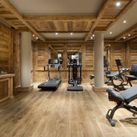
Gym
-
Style
- Modern/Contemporary
- Traditional
- Industrial
- Rustic
- Transitional
-
Price
- $$
- $$$
- $$$$
-
Size
- Compact
- Medium
- Large
-
Wall color
- White
- Gray
- Beige
- Blue
- Pink
- Turquoise
- Green
- Yellow
- Brown
- Orange
- Violet
- Red
- Black
- Ivory
-
Floor material
- LVT
- Hardwood
- Carpet
- Ceramic Tile
Basement Gym, Ideas, Designs and Cost Guide (Updated 2026)
-
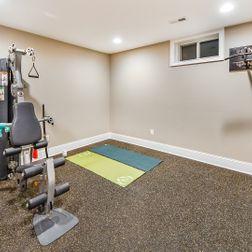
Neutral Transitional Basement With Wetbar - Olney, MD,
BasementRemodeling.com -
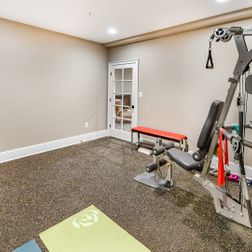
Neutral Transitional Basement With Wetbar - Olney, MD,
BasementRemodeling.com -
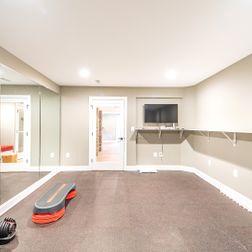
Chic Basement with Movie Theater Room, Family Room and Wet Bar, Warrenton, VA
BasementRemodeling.com -
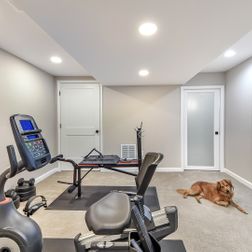
Basement Remodel with a custom shower/jacuzzi tub., Chevy Chase, MD
BasementRemodeling.com -
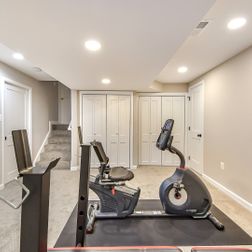
Basement Remodel with a custom shower/jacuzzi tub., Chevy Chase, MD
BasementRemodeling.com -
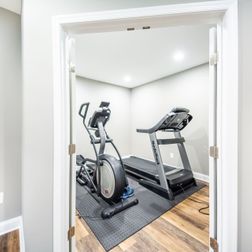
Basement Finishing and Remodeling, Vienna, VA
BasementRemodeling.com -
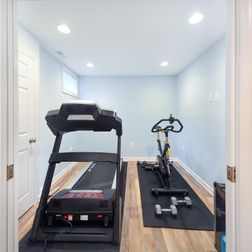
Basement Remodel - Small Gym
BasementRemodeling.com -
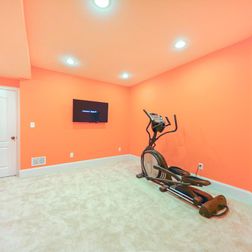
Basement Finishing / Remodeling, Project #10, Ellicott City, MD
BasementRemodeling.com
Quick Answer: How Much Does It Cost to Build a Basement Home Gym?
Building a basement gym space in the DC Metro area typically costs $2,000–$10,000 for an essential setup with proper flooring, basic ventilation, and electrical, $12,000–$20,000 for a premium build with dedicated ventilation, soundproofing, wraparound mirrors, and a subpanel for multiple circuits, and $20,000+ for a luxury space with a larger footprint and specialized buildout features. These costs cover the room itself, not the equipment you put in it.
The key insight: A basement home gym isn't just about the equipment. It's about the room itself. Flooring, ceiling height, ventilation, electrical capacity, moisture control, and soundproofing are what separate a gym you love using every day from one that ends up as expensive storage. Get the space right, and the equipment is the easy part.
Home Gym vs. Home Wellness Center: A Quick Distinction
These terms come up interchangeably, but they describe very different projects:
- Home Gym: A dedicated room designed for physical fitness, including strength training, cardio, and bodyweight exercise. Straightforward electrical and ventilation requirements. Typically 100–500+ square feet.
- Home Wellness Center: A holistic space that includes the gym plus recovery and relaxation features like saunas, cold plunges, steam rooms, yoga studios, and massage areas. Requires significantly more electrical, plumbing, HVAC, and waterproofing work. Typically 800–2,000+ square feet.
This article covers both, but the distinction matters because it changes your scope, your budget, and your remodeling requirements.
What Actually Qualifies as a Home Gym?
We see this question come up a lot, and the answer matters more than you'd think, especially from a real estate perspective. A home gym is a dedicated room or space within a residence that has been purposefully designed, equipped, and finished to serve as a primary workout area. A treadmill in the guest bedroom or a set of dumbbells in the corner doesn't qualify any more than a hot plate in the hallway makes a kitchen.
Five characteristics consistently distinguish a true home gym from a room that happens to have equipment in it.
Dedicated purpose is the most important distinction. The space is designated primarily for exercise, not a dual-use room that happens to have a stationary bike in the corner. From a real estate perspective, agents look for proper mats on the floors and, if it's in the basement, a finished room with some natural light.
Purposeful flooring is the most visible distinguishing feature between a real gym and equipment tossed into a room. Rubber gym flooring, interlocking tiles, stall mats, luxury vinyl, or cork flooring installed specifically for exercise replaces standard carpet or hardwood.
Appropriate infrastructure includes adequate electrical capacity with dedicated circuits for treadmills and other motorized equipment, proper ventilation, wall reinforcement for mounted equipment like mirrors and pull-up bars, and planned lighting that actually makes you want to spend time down there.
Sufficient space matters more than people realize. We recommend a minimum of 100 square feet for a basic home gym, with 200 to 500 square feet being the sweet spot for a space that combines both strength and cardio equipment.
Adequate ceiling height rounds out the list. You need a minimum of 7 feet to work with, though 8 feet or more is ideal if you plan on doing any overhead exercises. In basements, every inch of headroom counts.
What a Wellness Center Adds Beyond the Gym
The trend in high-end residential design has shifted noticeably in the last few years. Clients aren't just asking for homes that look good anymore. They want homes that feel good, that help them recover from the pace of modern life. The shift is from aesthetics to atmosphere, and we're seeing it play out in basements across the DC Metro area.
Recovery and thermal therapy is the most popular addition. This includes saunas (traditional Finnish, infrared, or both), steam rooms or steam showers, cold plunge pools, contrast therapy setups that cycle between hot and cold, red-light therapy panels, and compression therapy devices. These features aren't reserved for professional athletes or luxury spas anymore. They've become accessible to homeowners who want serious recovery tools at home.
Relaxation and mental wellness spaces round out the experience. These include meditation rooms, dedicated yoga or Pilates studio areas (sometimes with a barre), massage rooms, and spaces designed with sound therapy, aromatherapy, and soft lighting in mind.
At the ultra-luxury level, we're seeing homeowners add float tanks, salt rooms, and even dedicated biohacking stations. Niche features, but they're growing in popularity in high-end markets.
How the Buildout Requirements Differ
The distinction between gym and wellness center matters most when you're scoping a remodeling project. A standard home gym requires relatively straightforward construction: dedicated 120V electrical circuits, enhanced ventilation, reinforced walls for mounted equipment, and proper flooring. No plumbing is strictly required, though proximity to a bathroom is always nice.
A wellness center changes the equation. Traditional electric saunas require 240V service with 30 to 60 amp dedicated circuits and high-temperature rated wiring. Cold plunge units need water supply lines, drainage, and filtration systems. Steam rooms demand waterproof enclosures and dehumidification for adjacent spaces. You're often looking at a panel upgrade just to handle the cumulative electrical load.
The space requirements also expand. A home gym needs 100 to 500 square feet. A full home wellness center needs 800 to 2,000 or more square feet. A sauna alone takes up 24 to 48 square feet, a cold plunge adds another 35 square feet, and you need 60 to 100 square feet just for transition and rest zones between those features.
Gym vs. Wellness Center: Buildout Comparison
| Factor | Home Gym | Wellness Center |
|---|---|---|
| Size | 100–500+ sq ft | 800–2,000+ sq ft |
| Electrical | Dedicated 120V circuits (15–20A) | 240V/30–60A for saunas, panel upgrade likely |
| Plumbing | Not required (bathroom proximity nice) | Extensive (cold plunge, steam, drains) |
| HVAC | Enhanced ventilation + dehumidifier | Multi-zone HVAC, critical dehumidification |
| Permitting | Standard building permit | Additional plumbing/electrical permits likely |
| Typical cost (DC Metro) | $2,000–$20,000 (space buildout) | $20,000+ (space buildout) |
Basement Gym vs. Garage Gym: Which Is Better?
We hear this debate constantly, and we get it. Both spaces have real advantages. But after years of building out basement gyms in the DC Metro area, we can tell you that for the vast majority of homeowners in this region, the basement wins, and it isn't particularly close.
Where the Basement Dominates
Climate control is the basement's greatest advantage by a wide margin. Thanks to the earth's natural thermal mass, basements maintain relatively stable temperatures year-round, typically staying in the mid-60s in summer and upper 50s in winter without any HVAC at all. Garages are typically uninsulated and experience temperature swings from below freezing to well over 90 degrees. In the DC Metro's climate, with average July highs of 88 degrees, frequent 90-plus days, and winter lows dipping into the teens, an uninsulated garage is unusable four to five months out of the year.
Flooring quality favors basements because concrete slabs are generally flat and level, which is ideal for power racks and benches. Garage floors typically slope about a quarter inch per foot toward the door for water drainage. That means your barbells roll, your dumbbells drift, and your bench is never quite level.
Resale value strongly favors the basement. According to the NAR/NARI Remodeling Impact Report, a basement conversion to living area recovers approximately 86 percent of project cost at resale. Meanwhile, converting a garage is listed among projects to avoid for maximum ROI because eliminating parking deters many buyers.
Year-round usability, privacy, available space, and overall comfort all tilt toward the basement as well. You get consistent temperatures, natural sound isolation from the neighborhood, proximity to bathrooms and kitchens, and a footprint that typically matches the house itself, often 400 to 1,500 or more square feet. A standard two-car garage maxes out around 400 to 576 square feet.
Where the Garage Has the Edge
Ceiling height is the garage's most significant advantage. Typical garage ceilings reach 8 to 10 or more feet, while basement ceilings sit at 7 to 8 feet. That one to three foot difference is critical if you plan on doing standing overhead press, pull-ups on standard racks, box jumps, or Olympic lifts.
Moisture and humidity issues are less severe in garages. Basements are inherently prone to moisture wicking through concrete, condensation, and high humidity, particularly during DC's notoriously humid summers. Running a dehumidifier from May through September is basically a requirement.
Natural light and ventilation are far easier in garages. Opening the garage door floods the space with daylight and provides massive fresh air exchange. Most basements have limited natural light and poor natural ventilation.
Equipment accessibility is the garage's other major win. Ground-level access with wide openings means delivery trucks can pull right up. Getting a 500-pound power rack into a basement means navigating stairs, and often tight, turning stairways that'll test your patience and your walls.
The Full Comparison at a Glance
| Factor | Basement | Garage | Winner |
|---|---|---|---|
| Climate Control | Stable 58–68°F year-round | Wide swings: 20°F–95°F+ | Basement |
| Ceiling Height | 7–8 ft typical | 8–10+ ft typical | Garage |
| Flooring | Level concrete slab | Sloped for drainage | Basement |
| Noise | Good exterior isolation | Sound escapes outside | Tie |
| Moisture | Higher risk in summer | Lower risk, better airflow | Garage |
| Resale Value | Adds finished sq ft (86% ROI) | Losing garage hurts value | Basement |
| Year-Round Use | Excellent with dehumidifier | Tough 4–5 months w/o HVAC | Basement |
| Privacy | Maximum privacy | Less private | Basement |
| Natural Light | Very limited | Excellent, door open | Garage |
| Ventilation | Poor natural airflow | Excellent natural airflow | Garage |
| Comfort | Consistent, comfortable | Variable by season | Basement |
| Space Available | 400–1,500+ sq ft | 240–576 sq ft | Basement |
| Equipment Access | Difficult (stairs) | Easy (ground level) | Garage |
Home Gym Layouts That Actually Work
A good layout is the difference between a gym you use every day and one that collects dust. We've seen too many homeowners buy equipment first and figure out placement second. That approach almost always leads to cramped traffic flow, mirrors in the wrong spots, and equipment you can't use properly because there isn't enough room around it.
Cardio-Focused Layout
Place treadmills and ellipticals along the longest wall, facing a window if you have one or a wall-mounted TV if you don't. Position the stationary bike in a corner and the rowing machine along a side wall, keeping in mind that a rower needs about 9 feet of length when fully extended. Leave an open floor area in the center for jump rope and stretching. One important safety note: treadmills require at least 6 feet of clearance behind the running belt per ASTM safety standards, plus a minimum of about 20 inches on each side. Plan for roughly 30 square feet per treadmill, 20 per elliptical, 10 to 15 per bike, and 20 per rowing machine.
Strength and Powerlifting Layout
The power rack is your centerpiece. It has roughly a 4 by 4 foot footprint, but you need about 10 feet of width to accommodate a 7-foot Olympic barbell with room to load plates on both sides. Leave at least 2 feet between the rack and the wall behind it for comfortable squatting. Front to back, plan for 8 to 11 feet to fit a rack-plus-bench setup.
For basements with ceilings under 8 feet, use short racks. Several manufacturers make 72-inch models specifically for low-ceiling spaces. Place a dumbbell rack along a wall with a mirror directly in front for form checking, and keep a 6 by 7 foot working area in front of it. A deadlift zone needs roughly 8 by 6 feet of clear space, ideally on a lifting platform. In total, plan for 50 to 100 square feet just for the squat rack and its working area.
Mixed and Functional Training Layout
This is the most popular configuration we build, and it works by dividing the space into distinct zones. A cardio zone occupies one corner with a treadmill or bike and a screen. A strength zone takes the central area with adjustable dumbbells, a weight bench, and a compact rack. A functional zone provides open floor space for yoga mats, kettlebells, TRX suspension trainers, and bodyweight work. You can use different-colored flooring tiles, changes in lighting brightness, or simple equipment placement to create natural boundaries between zones without building walls.
Yoga and Flexibility Layout
Minimum open floor space is 6 by 8 feet per person. Use soft, warm lighting, earthy tones, and natural materials for a calming atmosphere. Full-length mirrors on one wall help with form. Minimize clutter by using wall-mounted shelving or cubbies for mats, blocks, and straps. If you have a window, place mirrors perpendicular to it to distribute natural light without bouncing it back outside.
Multi-Zone Layout
The gold standard for larger basements, this layout creates four distinct zones: strength (power rack and barbell area anchored against one wall), cardio (treadmill, bike, and rower along another wall, preferably near ventilation), functional/floor (open center area), and storage/recovery (wall-mounted racks, shelving, foam rollers, and a cooling station). With 400 or more square feet, this layout gives you the feel of a well-organized commercial gym in your own home.
Core Design Principles for Any Layout
Traffic flow should allow a clear main path through the gym without stepping over equipment. Equipment spacing follows the general rule of 2 to 3 feet of clearance around each piece. Mirror placement should prioritize the area in front of the power rack first, then a lateral position beside the rack for side-angle form checks, and finally the open stretching area. Keep mirrors away from weight storage areas, because bouncing dumbbells are the number one mirror breaker in home gyms. Separate your heavy lifting zone from any shared walls with living spaces above to minimize noise transfer.
How Big Should Your Basement Gym Be?
Size determines what's possible, so let's walk through three tiers: the minimum gym, the solid mid-size gym, and the dream gym.
The Minimum Gym: 100 to 200 Square Feet
The practical minimum for barbell training is 100 square feet, which is a 10 by 10 foot room. A 10 by 12 room at 120 square feet matches a typical spare bedroom conversion and gives you a bit more breathing room. At this size, you can fit a squat stand or compact power rack (a short version for basements), an Olympic barbell and weight plates up to 300 pounds, an adjustable bench, and adjustable dumbbells like PowerBlock or Bowflex SelectTech, which replace an entire dumbbell rack in a single compact unit.
With this setup, you can do squats, bench press, overhead press, deadlifts, barbell rows, dumbbell work, pull-ups, and bodyweight exercises. What won't fit: a cardio machine alongside a full barbell setup, cable machines, or room for multiple people to train at once. Space-saving strategies include wall-mounted folding racks that extend just 5 to 15 inches from the wall when folded, and adjustable dumbbells that replace 10 to 15 pairs of fixed dumbbells.
The Medium Gym: 200 to 400 Square Feet
This is the sweet spot for most homeowners, roughly the size of a single-car garage. At 200 to 400 square feet, you can accommodate a full power rack with pull-up bar, Olympic barbell with a full plate set, adjustable bench, a dumbbell set or adjustable dumbbells, one to two cardio machines (treadmill, rower, bike, or air bike), a cable machine or functional trainer, and accessories like kettlebells, plyo boxes, and medicine balls.
At 300 square feet, you comfortably fit a power cage, dumbbell and kettlebell storage racks, bench, plyo box, a large cardio machine, and a lifting platform. At 400 square feet, add a cable station or leg press machine with room for two people to train simultaneously. Common dimensions we see work well are 12 by 20, 15 by 20, and 20 by 20 feet.
The Dream Gym: 400 to 1,000+ Square Feet
At 400 square feet and up, the possibilities open wide. The entry-level dream gym starts at 400 to 500 square feet, with a full dream build at 500 to 800 square feet and an ultimate wellness-integrated space at 800 to 1,500 or more square feet. At this scale, you have everything from the medium tier plus a full-size power cage with attachments, multiple specialty barbells, a complete dumbbell set from 5 to 100 or more pounds on commercial racks, a full bumper plate set, a cable crossover machine, dedicated machines like a leg press and GHD, and two to three cardio machines.
Perhaps most importantly for a basement remodeling project, this is the size where recovery and wellness zones become practical. You can add a sauna, a cold plunge tub, a dedicated stretching and yoga zone, compression therapy equipment, and a massage chair. The supporting infrastructure at this level includes a full bathroom with shower, full wall mirrors, professional rubber flooring throughout, zoned LED lighting, surround sound, climate control with a dedicated HVAC zone, and a mini fridge or hydration station.
Basement Remodeling Considerations from Floor to Ceiling
This is where our expertise as builders really shows. You can buy the best equipment on the market, but if the space underneath it isn't right, you'll never use it the way you planned. In a basement, that means addressing moisture management, electrical capacity, soundproofing, and a handful of other factors that most homeowners don't think about until something goes wrong.
Flooring: The Foundation of Every Basement Gym
Rubber flooring is the standard recommendation for home gyms, and for good reason. Rubber rolls cost $1 to $5 per square foot, provide a seamless look, and are the best choice for heavy lifting. We recommend three-quarter inch thickness as a minimum for serious weightlifting. Interlocking rubber tiles run $3 to $10 per square foot, require no adhesive, and allow you to replace individual damaged tiles without redoing the whole floor.
The classic budget option that we see working well is horse stall mats from Tractor Supply at roughly $45 to $50 per 4 by 6 foot mat. Industrial-grade, extremely durable, and three-quarters of an inch thick. Foam tiles at $1 to $4 per square foot are only appropriate for dedicated stretching or yoga zones because they compress and deform under heavy equipment. Vinyl or luxury vinyl plank at $3 to $7 per square foot works for cardio areas but dents under heavy free weights.
Subfloor preparation is critical in basements. Always install a 6-mil polyethylene vapor barrier over concrete before any flooring goes down. Clean and repair cracks, address any efflorescence, and consider waterproofing walls with masonry waterproofing products. A dimpled membrane underlayment or subfloor panel system creates an air gap to prevent moisture wicking, which matters a lot in the DC Metro's humid climate.
Ceiling Height: Making Every Inch Count
The International Residential Code requires a minimum 7-foot ceiling height for habitable basement spaces, with beams, ducts, and other obstructions permitted to project down to no less than 6 feet 4 inches. DC's housing code mirrors these requirements. Typical DC Metro basement ceilings range from 6.5 to 7 feet in pre-1950 rowhouses, 8 to 9 feet in homes built since the 1980s, and 9 or more feet in newer construction.
For exercise, here is what you actually need. Standing overhead press requires 8 to 9 feet minimum (your height plus arm extension plus the barbell). Pull-ups need 8.5 to 9 feet or more. Box jumps need at least 8 feet. Even treadmills and ellipticals add 6 to 12 inches of elevation, making 7.5 to 8 feet the minimum for cardio machines.
Exposed and painted ceilings are our go-to recommendation for basement gyms. Spray-painting the exposed joists, pipes, and ductwork in flat black or dark gray is a popular, budget-friendly approach that creates an industrial aesthetic while maximizing every inch of usable height. Drop ceilings provide easy access to mechanicals and acoustic dampening, but they sacrifice 4 to 6 inches of headroom, which is often intolerable in already-low basements.
Lighting: Turning a Dark Basement into an Energizing Space
Good lighting transforms a basement gym from a dungeon into a space that actually motivates you. We target 20 to 50 foot-candles for general gym use, with 30 to 50 foot-candles in weight training areas. For a 300-square-foot gym, that translates to roughly 24,000 lumens total, or about 50 to 80 lumens per square foot.
LED color temperature makes a real difference. Use 4000K to 5000K for energizing workouts, which mimics natural daylight, and 2700K to 3000K for yoga or cool-down zones. Smart lighting systems let you create programmable scenes, so one button press gives you bright, cool light for an intense lifting session, and another gives you dim, warm light for stretching and recovery.
Fixture options include recessed LED downlights for a clean look in low ceilings, LED flat panels for dropped ceilings, and LED shop lights for budget-friendly, high-output illumination. Mount lights above or beside mirrors, never directly opposite them, and use diffused fixtures with frosted lenses to avoid blinding glare. If your budget allows, an egress window installation ($2,700 to $5,900) brings natural light into the basement and doubles as an emergency exit.
Ventilation, HVAC, and Dehumidification
Ventilation is one of the most overlooked aspects of basement gym design, and one of the most important once you start using the space. Exercise spaces should have 6 to 10 air changes per hour according to ASHRAE guidelines. For a 300-square-foot room with 8-foot ceilings, that translates to roughly 240 CFM of airflow. People exercising generate 400 to 600 or more BTU per hour of heat, plus significant moisture, far more than someone sitting at a desk.
Dehumidification is non-negotiable in DC Metro basements. We target 30 to 50 percent relative humidity, because above 60 percent, you're inviting mold growth. A portable dehumidifier costs $150 to $500 for a 30 to 70 pint capacity unit; whole-house or HVAC-integrated units run $1,300 to $2,800 installed. In our area, dehumidifiers typically run constantly from May through September.
For climate control, a ductless mini-split is our preferred solution for basement gyms. It provides independent heating and cooling with zone control for $3,000 to $7,000 installed. However, mini-splits handle temperature well but may not adequately address humidity on their own, so a separate dehumidifier remains essential even with a mini-split system in place.
Electrical: Powering Your Equipment Safely
Plan for 3 to 5 dedicated circuits minimum in a well-equipped gym. The single most important thing we can tell you is this: treadmills require a dedicated 20-amp, 120V circuit each. This is non-negotiable and the most common electrical issue we see in home gyms. Running a treadmill on a shared circuit with other equipment or household items causes motor strain, tripped breakers, and premature equipment failure.
Ellipticals and rowing machines also benefit from dedicated 20-amp circuits. Your entertainment system, lighting, and HVAC or dehumidifier each need their own circuits as well. Some commercial equipment and saunas require 240V service, which may mean adding a subpanel if the gym is far from your main electrical panel.
Place outlets every 6 feet along walls per NEC requirements, with dedicated outlets at each piece of motorized equipment. Position outlets at 48-inch height for wall-mounted TVs and at floor level near cardio equipment locations. All basement receptacles require GFCI protection under NEC code. One practical tip: treadmills commonly cause GFCI nuisance tripping, so we recommend GFCI breakers at the panel rather than GFCI outlets at the point of use, because breakers tend to trip less frequently from the motor's electrical noise.
Mirrors and Wall Treatments
Weight training mirrors should be at minimum 48 by 84 inches per person, with full wall coverage being ideal for comprehensive form checking. We recommend tempered glass mirrors at quarter-inch thickness. They offer superior clarity without distortion, they're scratch-resistant, and they're safer if something does make contact. Glass mirrors cost $5 to $15 per square foot installed, while acrylic alternatives cost $3 to $8 per square foot but scratch easily and warp over time.
Install mirrors using mirror mastic adhesive with a J-channel on the bottom edge for structural support. Never use silicone or liquid nails, as they damage the mirror's silvering. And always glue mirrors to the wall, because clips alone are dangerous in a gym environment where vibration from dropped weights can work them loose.
Walls near squat racks and deadlift areas need protection: rubber bumpers, stall mats mounted vertically on the walls, or 2 to 4 inch foam padding. Use moisture-resistant, mold-resistant paint in a semi-gloss or satin finish for easy cleaning. Lighter colors reflect light and make the space feel larger, while a bold accent wall with motivational graphics can create energy in the training zone.
Soundproofing: Protecting the Living Spaces Above
If your family is going to sleep, work, or watch TV above your gym, soundproofing isn't optional. We target STC 50 to 60 (Sound Transmission Class) for a home gym ceiling, where conversations become unintelligible and loud sounds are significantly dampened. A standard uninsulated ceiling rates only STC 33, so there's a lot of ground to make up.
The proven approach layers four principles. Insulation in joist cavities using mineral wool gets you to about STC 45. Decoupling with sound isolation clips and resilient channel separates the ceiling drywall from the joists so vibrations cannot transfer directly. Mass added through a double layer of five-eighths-inch drywall with a vibration-dampening compound between layers significantly increases sound blocking. Sealing every gap, crack, and edge with acoustic caulking prevents sound flanking. This full assembly can achieve STC 66 to 76, which is excellent.
Floor impact noise from dropped weights is addressed primarily through three-quarter-inch or thicker rubber flooring. Deadlift platforms built with layers of plywood and rubber horse stall mats provide additional protection. For a 400-square-foot basement gym ceiling, expect to spend $760 to $3,200 depending on which approach you choose.
Plumbing: Bathrooms, Saunas, and Cold Plunges
A post-workout bathroom makes a huge difference in a basement gym's convenience and resale appeal. Since basement fixtures are typically below the main sewer line, a sewage ejector pump is required, costing $1,900 to $5,500 installed. A basic half-bath addition costs $5,000 to $15,000 while a full bathroom with shower runs $15,000 to $30,000 or more.
Cold plunge installation requires a water supply connection, drainage (a floor drain is ideal), and a GFCI-protected outlet for the chiller unit. Keep in mind that a filled 100-gallon plunge weighs approximately 830 pounds, so verify floor support and position it across multiple floor joists if not on a concrete slab. Saunas need a 240V, 30 to 60 amp dedicated circuit for the heater, floor drains for cleanup, and dedicated intake and exhaust ventilation. Smaller infrared saunas may operate on standard 120V/20A circuits, making them a more straightforward addition.
Storage, Entertainment, and Safety
Smart storage keeps a gym functional and safe. Wall-mounted systems like pegboard ($1 to $3 per square foot), slatwall panels ($3 to $8 per square foot), and dedicated barbell holders and weight racks keep equipment off the floor and organized. Built-in cabinets provide a cleaner, more finished look for $500 to $3,000 or more.
For entertainment, a wall-mounted 50 to 65 inch TV on an articulating arm mount ($30 to $100) positioned at eye level from your primary equipment location is the standard. A mesh WiFi system or dedicated access point addresses the signal weakness common in below-grade spaces. Hardwired Ethernet is always preferred for streaming equipment like Peloton or Tonal.
Safety requirements include emergency egress per building code, which means egress windows with a minimum 5.7 square feet of net clear opening, a minimum 24-inch height, 20-inch width, and a maximum 44-inch sill height. Smoke detectors are required in all habitable basement rooms, hardwired with battery backup. Mount an ABC-rated fire extinguisher near the exit, bolt power racks to the floor with concrete anchors for stability, and always maintain clear, unobstructed exit routes.
How Much Does It Cost to Build a Basement Gym Space?
Now let's put real numbers to everything we've covered. These costs cover the room itself, the space you're building, not the equipment you'll put in it. You'll purchase your equipment separately based on your fitness goals and budget. Our job is to make sure the room is ready for whatever you want to do in it.
All figures reflect DC Metro area pricing. Actual costs vary based on the size of the space, existing conditions, and the specific features you choose.
Essential Basement Gym Space: $2,000 to $10,000
This is the most common tier we build. Most homeowners simply want a room that's properly set up to support gym equipment, and that's exactly what this covers. At this level, you're looking at appropriate gym flooring (rubber rolls, interlocking tiles, or horse stall mats), basic lighting improvements if needed, paint, and ensuring the space has adequate electrical outlets and ventilation for the equipment you plan to bring in.
Where you land within the $2,000 to $10,000 range depends on several factors: the size of the space, your flooring choice (horse stall mats at the low end versus premium rubber tiles at the high end), whether your current ventilation setup is adequate or needs improvement, whether you want mirrors, and how much electrical work is needed to support your current or future equipment. A smaller space with budget flooring and minimal electrical work will come in toward the lower end. A larger room with premium flooring, a full wall of mirrors, and additional outlets pushes toward the higher end.
For most homeowners, this tier delivers everything you need to start training. The room is clean, the floor protects both your equipment and your concrete, the lighting works, and the outlets are where you need them.
Premium Basement Gym Space: $12,000 to $20,000
This tier is for homeowners who want a gym space that performs at a higher level. The difference between essential and premium comes down to comfort, noise control, and electrical capacity.
At this level, you're adding dedicated ventilation to manage airflow and humidity during intense workouts, soundproofing the ceiling so your family isn't listening to every dropped weight, wraparound mirrors for comprehensive form checking from multiple angles, and dedicated electrical circuits or a subpanel to support multiple pieces of motorized equipment running simultaneously. If you plan on running a treadmill, an air conditioning unit, a dehumidifier, and a sound system all at the same time, this is the tier that makes that possible without tripping breakers.
The premium tier also typically includes higher-end flooring, professional-grade lighting with dimmable or zoned controls, and finished wall treatments that make the space feel like a real gym rather than a converted basement.
Luxury Basement Gym Space: $20,000 and Up
This tier is for homeowners who want a larger, more complex space that supports specialized features. At this level, you're typically working with a bigger footprint, and the buildout reflects that. You may be adding a bathroom with shower for post-workout convenience, a sauna or cold plunge with the plumbing and electrical to support it, multi-zone HVAC for independent climate control, or extensive soundproofing and custom finishes throughout.
How far above $20,000 depends entirely on what you want in the space. A larger gym room with a half-bath and premium finishes might come in around $30,000 to $50,000. A full wellness center with a sauna, cold plunge, dedicated bathroom, and high-end everything can reach well into six figures. The buildout complexity scales with the features you choose.
Cost Summary at a Glance
| Category | Essential | Premium | Luxury |
|---|---|---|---|
| What you get | Gym-ready room with flooring, lighting, paint, basic electrical | Dedicated ventilation, soundproofing, wraparound mirrors, subpanel | Larger space, bathroom, sauna/cold plunge, multi-zone HVAC, custom finishes |
| Space buildout cost | $2K–$10K | $12K–$20K | $20K+ |
| Key cost drivers | Space size, flooring choice, electrical needs, mirrors | Soundproofing method, HVAC upgrades, electrical capacity | Plumbing, sauna/cold plunge, space size, finish level |
Cost Drivers That Push Higher
- Underpinning or slab lowering needed for ceiling height
- Full bathroom addition with plumbing
- Sauna or cold plunge installation
- Professional soundproofing (isolation clips, double drywall)
- Subpanel and multiple dedicated circuits
Cost Drivers That Keep Things Moderate
- Adequate existing ceiling height (7+ feet)
- Dry basement with no water issues
- Existing ventilation and electrical are sufficient
- Horse stall mats instead of premium rubber tile
- Exposed painted ceiling instead of drywall
Frequently Asked Questions
Is a basement gym better than a garage gym?
For most DC Metro homeowners, yes. Basements offer stable year-round temperatures, level flooring, more usable square footage, greater privacy, and stronger resale value. Garages win on ceiling height, natural light, ventilation, and equipment accessibility. Serious powerlifters and Olympic lifters who need maximum headroom may prefer a garage.
What is the minimum size for a home gym?
The practical minimum for barbell training is 100 square feet (a 10 by 10 foot room). A 10 by 12 room at 120 square feet gives you a bit more breathing room. The sweet spot for most homeowners is 200 to 400 square feet, which accommodates a power rack, bench, cardio machine, and accessories with room to move.
What ceiling height do I need for a basement gym?
Building code requires a minimum of 7 feet for habitable basement spaces (6 feet 4 inches under beams and ducts). For exercise, standing overhead press re
Thank you! Your message has been received!
Thank you! You will receive your quote within minutes!
Thank you! Your quote has been submitted successfully!
Finish your quote

Other photos in this project